Microbial control and disinfection
Effective action against bacteria, viruses, fungi, and other microorganisms, including aerobic and anaerobic organisms.
A technical report on POCS™ and OxQuantum: advanced oxidation, disinfection, singlet-oxygen generation, and process control for water, wastewater, and environmental treatment.
POCS™ | Chlorine-Silicon Polyoxide
POCS™ (Chlorine-Silicon Polyoxide) is a proprietary high-performance advanced oxidation and disinfection technology developed for water and sanitation applications, including potable-water treatment, industrial and municipal wastewater treatment, process-water management, and the remediation and restoration of water bodies.
Its formulation is engineered to provide advanced oxidative action and disinfection across a wide range of water matrices, enabling microbial control, oxidation and reduction of organic loads, odour control, biofilm degradation, algae control, improvement of dissolved-oxygen conditions, and broader improvement of physicochemical water-quality parameters.
The oxidative action of POCS™ achieves greater reaction efficiency and operational stability than conventional treatment approaches based on hypochlorite and traditional chlorination chemistry. Treatment efficiency is maintained independently of pH, allowing consistent oxidative performance across a broad range of water conditions.
POCS™ also achieves the required treatment effect at substantially lower operating doses than conventional oxidants, reducing chemical consumption, chemical-storage requirements, logistical demand, and operating costs.
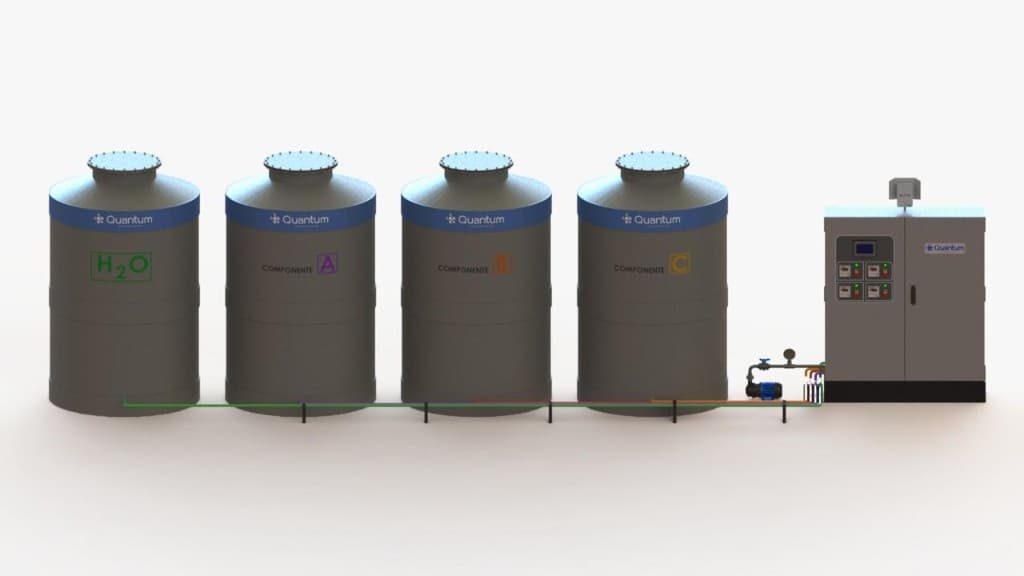
POCS™ is applied through a modular dosing arrangement that stores water and the treatment components separately, then delivers them under automated control.
The oxidative action of POCS™ enables multiple treatment functions simultaneously within water, wastewater, and environmental-remediation processes.
Effective action against bacteria, viruses, fungi, and other microorganisms, including aerobic and anaerobic organisms.
Acts on oxidisable organic compounds and reduces organic load.
Oxidises reduced sulphur compounds and other substances responsible for unpleasant odours, including sulphides and hydrogen sulphides.
Degrades established biofilms and controls the microbial structures responsible for their formation and persistence.
Controls algae and associated biological proliferation in treatment systems and water bodies.
Improves turbidity and apparent colour while supporting more efficient coagulation and clarification.
Reduces oxidisable loads associated with biochemical and chemical oxygen demand.
Improves dissolved-oxygen availability in treated water and water bodies as organic and reducing loads are oxidised.
Supports broad improvements across multiple water-quality parameters.
Maintains effective oxidative action without depending on a narrow pH range for treatment efficiency.
POCS™ combines high oxidative capacity with low dosing requirements. Compared with conventional hypochlorite and traditional chlorination systems, it requires significantly lower volumes of treatment chemical to achieve the required oxidation and disinfection effect.
The reduction in chemical volumes required also simplifies logistics and enables facilities to maintain smaller inventories while achieving stronger treatment performance.
POCS™ can be incorporated into new or existing treatment trains without requiring the replacement of treatment stages that continue to perform necessary physical or biological functions. Depending on the application, it may be integrated for:
This approach allows POCS™ to function as a highly efficient oxidation and disinfection layer within existing treatment processes while improving their overall operational performance. Applications have demonstrated improvements in microbiological indicators, turbidity, colour, organic load, odour-related parameters, and dissolved oxygen.
POCS™ can be incorporated into public and private potable-water treatment systems for oxidation, disinfection, microbiological control, clarification support, and residual management. Depending on the treatment architecture, it may be applied during pre-oxidation, intermediate treatment, and final disinfection stages.
Supports industrial water-management systems in process-water circuits, storage tanks, reservoirs, cooling systems, and other industrial water loops requiring continuous oxidative treatment.
Can be integrated into industrial wastewater-treatment systems to reduce oxidisable organic load, BOD and COD, oils and greases, and odour-related compounds, including prior to discharge or reuse.
Can be incorporated into wastewater-treatment plants for oxidation, disinfection, organic-load reduction, and final effluent polishing without replacing treatment stages that continue to perform necessary physical or biological functions.
Particularly suitable for rivers, lakes, reservoirs, lagoons, urban canals, and other water bodies affected by organic pollution, microbiological contamination, algae, biofilms, odours, or degraded water quality.
Applicable in agricultural, livestock, and aquaculture systems that require continuous treatment without excessive chemical consumption.
Powerful oxidative action across a broad range of water and wastewater treatment conditions.
Higher reaction efficiency than conventional hypochlorite and chlorination-based treatment systems.
More stable treatment performance than conventional chlorine-based oxidants.
Maintains effective oxidation across different pH conditions without relying on a narrow optimum pH range.
Control of bacteria, viruses, fungi, and other microorganisms, including aerobic and anaerobic organisms.
Degrades established biofilms and helps prevent their persistence within water systems and treatment infrastructure.
Controls algae and associated biological proliferation in water-treatment systems and water bodies.
Oxidises reduced sulphur compounds and other odour-associated contaminants.
Reduces oxidisable organic load, including BOD and COD.
Increases dissolved-oxygen availability in treated water and degraded water bodies.
Improves turbidity and apparent colour while supporting more efficient coagulation and clarification.
Requires significantly lower chemical volumes than conventional hypochlorite and traditional chlorination systems.
Reduces chemical purchasing, transportation, storage, handling, and operational costs.
Supports the generation and maintenance of an effective oxidising and disinfectant residual.
Can be incorporated into existing treatment systems without wholesale replacement of established infrastructure.
Applicable across potable water, process water, wastewater, sanitation, and environmental-remediation applications.
POCS™ is an oxidising chemical and must be stored, handled, dosed, and monitored in accordance with its applicable Safety Data Sheet and operating procedures. Where it replaces conventional oxidants such as chlorine gas, calcium hypochlorite, sodium hypochlorite, or other aggressive chlorine-based products, it can substantially reduce the logistical and operational risks associated with those chemicals.
Appropriate chemical-management procedures, personnel training, compatible materials, personal protective equipment, and controlled storage remain required.
POCS™ provides effective oxidation and disinfection using substantially lower chemical quantities than conventional treatment systems.
These characteristics allow POCS™ to combine high treatment performance with ease of use and implementation, enabling its usage in especially complicated areas.
POCS™ represents a new generation of oxidation and disinfection technology for water, wastewater, and environmental-treatment applications. Its value extends beyond the supply of a chemical product: it functions as an integrated treatment technology capable of improving oxidation, disinfection, organic-load reduction, biofilm and algae control, dissolved-oxygen conditions, and overall water quality while reducing chemical consumption and operating costs.
The result is a flexible, efficient, and scalable platform for improving water quality, strengthening sanitation infrastructure, and supporting the restoration and responsible management of water resources.
OxQuantum | Advanced oxidation and process-control platform
An advanced oxidation platform designed to complement POCS™ in applications requiring additional oxidative performance, automation, and process control.
OxQuantum (also known as Quantum Oxygen) is an advanced oxidation platform designed to complement POCS™ rather than replace the baseline chemistry it provides. It extends the treatment architecture through controlled singlet-oxygen (¹O₂) generation, automated dosing, and real-time process optimisation.
The platform is particularly relevant to complex, high-throughput, or operationally demanding treatment environments in which oxidation performance must be continuously managed against changing water conditions.
OxQuantum provides powerful oxidative treatment without generating harmful disinfection by-products associated with conventional chlorination chemistry, allowing advanced oxidation to be achieved without introducing the undesirable compounds commonly associated with aggressive chlorine-based treatment.
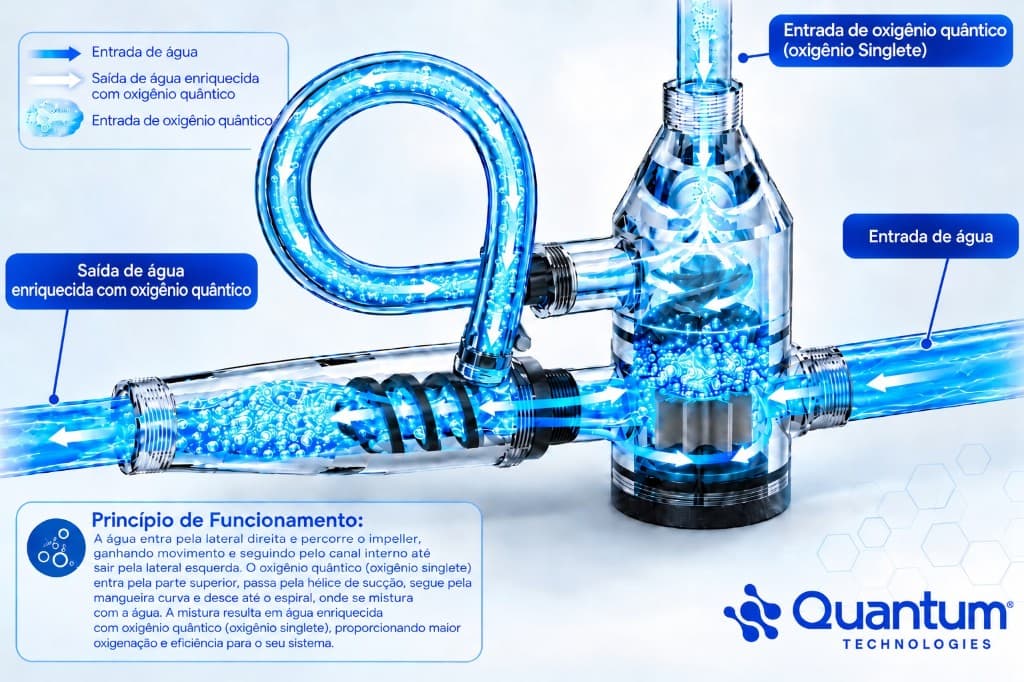
OxQuantum generates singlet oxygen (¹O₂), a highly reactive form of molecular oxygen capable of driving advanced oxidation reactions. Water enters from the right-hand side, travels through the impeller, and exits on the left. Singlet oxygen enters from the top, follows the curved hose, and mixes with the water in the spiral.
Its oxidative action targets treatment challenges including:
Singlet oxygen possesses strong electron-transfer and oxidation capacity, enabling rapid reaction with susceptible contaminants while ultimately returning to the normal ground state of molecular oxygen. This allows OxQuantum to provide powerful oxidative treatment without generating harmful treatment by-products.
Rather than relying solely on fixed chemical dosing, OxQuantum integrates oxidation with automated process control. Depending on system configuration, the technology incorporates automated dosing and control logic, allowing treatment conditions to respond continuously to operational requirements.
POCS™ and OxQuantum occupy complementary roles. POCS™ provides the core oxidation and disinfection chemistry. OxQuantum adds an advanced singlet-oxygen oxidation and process-control layer where the complexity, scale, or performance requirements of the application justify additional integration. A typical deployment philosophy is:
This staged architecture enables treatment capability to scale according to the requirements of the application.
A principal differentiator of OxQuantum is the integration of advanced oxidation with automated operating control.
Delivers treatment inputs according to actual process requirements.
Adjusts operation as treatment conditions change.
Reduces dependence on manual treatment adjustments.
Maintains greater control across variable water matrices and flow conditions.
Avoids unnecessary chemical addition through precise treatment control.
Reduces chemical consumption, operator intervention, and inefficient treatment.
Supports high-throughput and operationally complex treatment environments.
OxQuantum can complement oxidation and disinfection processes in potable-water systems requiring advanced oxidation, improved process control, or reduced dependence on conventional chlorine-based treatment. Singlet-oxygen generation provides a highly reactive oxidation pathway while avoiding harmful disinfection by-products associated with traditional chlorination chemistry.
Particularly suited to industrial systems characterised by variable loads, complex contaminants, or high treatment throughput, including oxidation of complex organic compounds, microbial and biofilm control, odour and sulphide management, oxidative polishing, process stabilisation, and support for water reuse.
Provides an additional advanced-oxidation layer within municipal wastewater-treatment systems, particularly for final polishing, disinfection, organic-load reduction, and applications requiring greater automated process control, without generating harmful chlorination by-products.
Can be incorporated into remediation and restoration programmes for rivers, lakes, reservoirs, lagoons, canals, and other water bodies. Because the oxidation process does not generate harmful treatment by-products, OxQuantum is particularly suited to environmental applications where restoration of the water body itself is the treatment objective.
Supports agricultural and aquaculture systems requiring controlled oxidation, microbial management, biofilm and algae control, improved dissolved oxygen, and precision treatment management.
Provides a powerful advanced-oxidation pathway based on controlled generation of ¹O₂.
Advanced oxidation without the harmful disinfection by-products associated with conventional chlorination chemistry.
Extends the treatment architecture without replacing the underlying POCS™ chemistry.
Combines oxidation with precision dosing and treatment-control logic.
Continuously adapts treatment to changes in process conditions.
Supports applications where scale or process complexity requires a more sophisticated oxidation platform.
Reduces dependence on conventional chemical oxidants and avoids unnecessary chemical addition.
Reduces chemical requirements, handling, storage, and inefficient treatment expenditure.
Provides an advanced oxidation pathway that does not depend primarily on hypochlorite or traditional chlorination.
Can be incorporated as an additional oxidation and control layer within existing water and wastewater-treatment systems.
OxQuantum reduces dependence on highly hazardous conventional oxidants by generating its advanced oxidation capacity through controlled singlet-oxygen production. Automated process-control functionality also reduces unnecessary manual intervention, improves dosing consistency, and reduces excessive chemical treatment.
Appropriate engineering controls, operating procedures, and monitoring remain essential.
OxQuantum is based on controlled advanced oxidation rather than indiscriminate chemical addition. By combining singlet-oxygen generation with automated process control, the platform provides:
The sustainability advantage derives from achieving stronger oxidative performance while reducing reliance on conventional chemical treatment and avoiding harmful treatment by-products.
OxQuantum expands the treatment capability established by POCS™ by combining advanced singlet-oxygen oxidation with automation and real-time process control. POCS™ remains the core treatment technology, while OxQuantum provides an additional layer of oxidative capacity, precision, and automation for applications requiring greater treatment performance.
Together, POCS™ and OxQuantum create a scalable treatment architecture capable of progressing from highly efficient chemical oxidation and disinfection to integrated, monitored, and automatically optimised water treatment. The combined platform delivers greater reaction efficiency, lower chemical consumption, reduced operating costs, improved dissolved-oxygen conditions, and advanced treatment performance without generating the harmful by-products associated with conventional chlorination.